Develop your Hawkeye: Enhancing visual abilities with vagus nerve stimulation
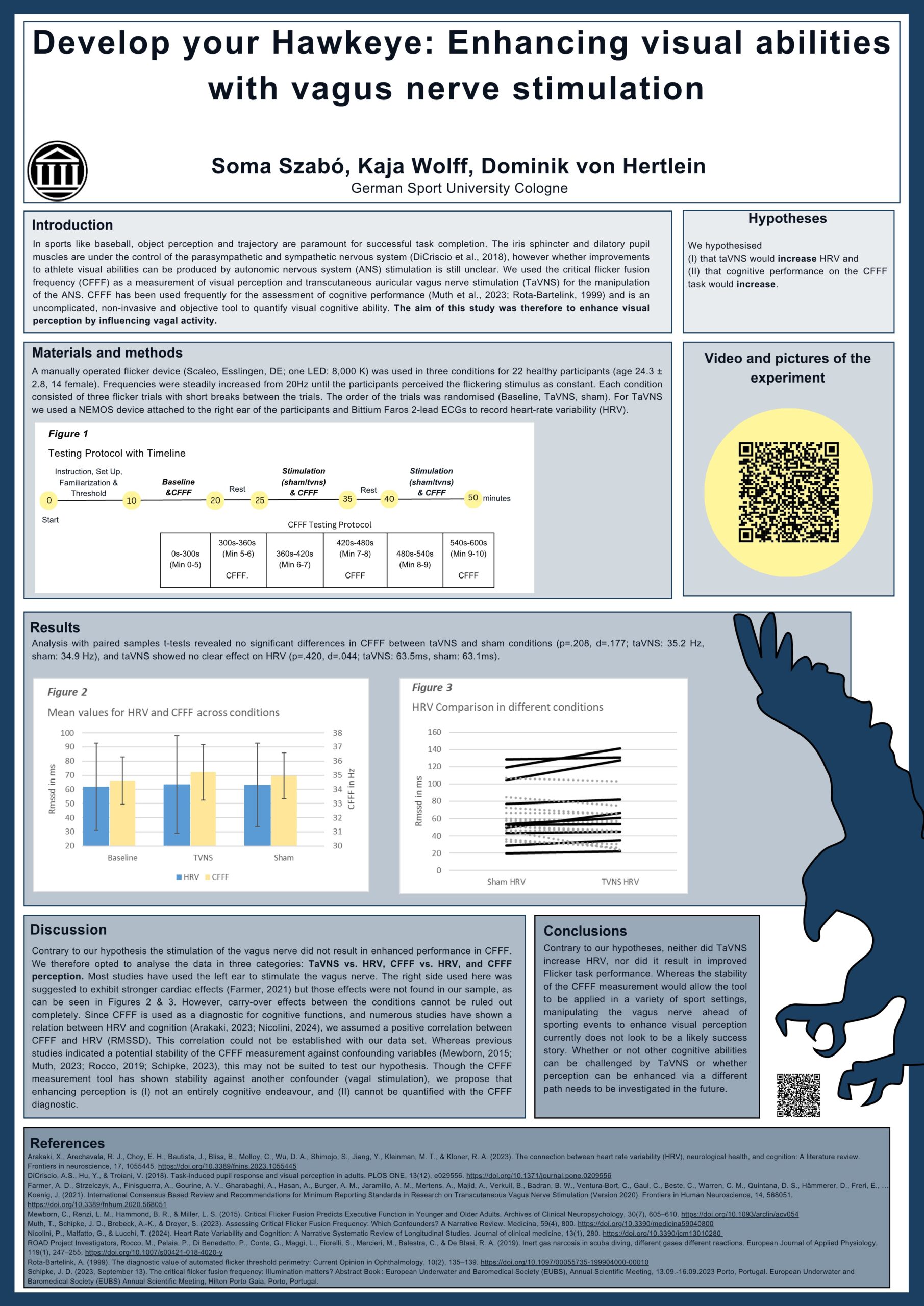
This study explored the impact of transcutaneous auricular vagus nerve stimulation (taVNS) on heart rate variability (HRV) and visual perception, assessed through critical flicker fusion frequency (CFFF), which predicts cognitive functioning. Understanding these links, particularly in sports like baseball, may be relevant for performance enhancement. We hypothesised (I) that taVNS would increase HRV and (II) that cognitive performance on the CFFF task would increase. Twenty-two participants (average age 24.3 ± 2.8, 14 female) underwent cognitive assessment using electrodes from a NEMOS device on their right ear, while HRV was recorded with a two-lead ECG (Bittium Faros). Analysis via paired samples t-test revealed no significant differences in CFFF between taVNS and sham conditions (p=.208, d=.177; taVNS: 35.2 Hz, sham: 34.9 Hz), and taVNS showed no clear effect on HRV (p=.420, d=.044; taVNS: 63.5ms, sham: 63.1ms). Contrary to expectations, vagus nerve stimulation did not enhance CFFF performance, nor did it result in changes to HRV. These results allow three further conclusions. First, taVNS does not seem to influence heart rate variability, irrespective of the side of stimulation. Second, both HRV and CFFF show correlations to cognition, however, CFFF does not seem suited to quantify a purely perceptive task. And third, even though HRV, taVNS, and CFFF may influence cognitive aspects, improvements to visual perception apparently cannot be achieved by combining these parameters. Finally, and providing that CFFF as a diagnostic remained stable against vagal stimulation, the CFFF measurement may still be valuable in a variety of sport settings but requires further investigation.