Effects of transcutaneous vagus nerve stimulation on visual processing ability
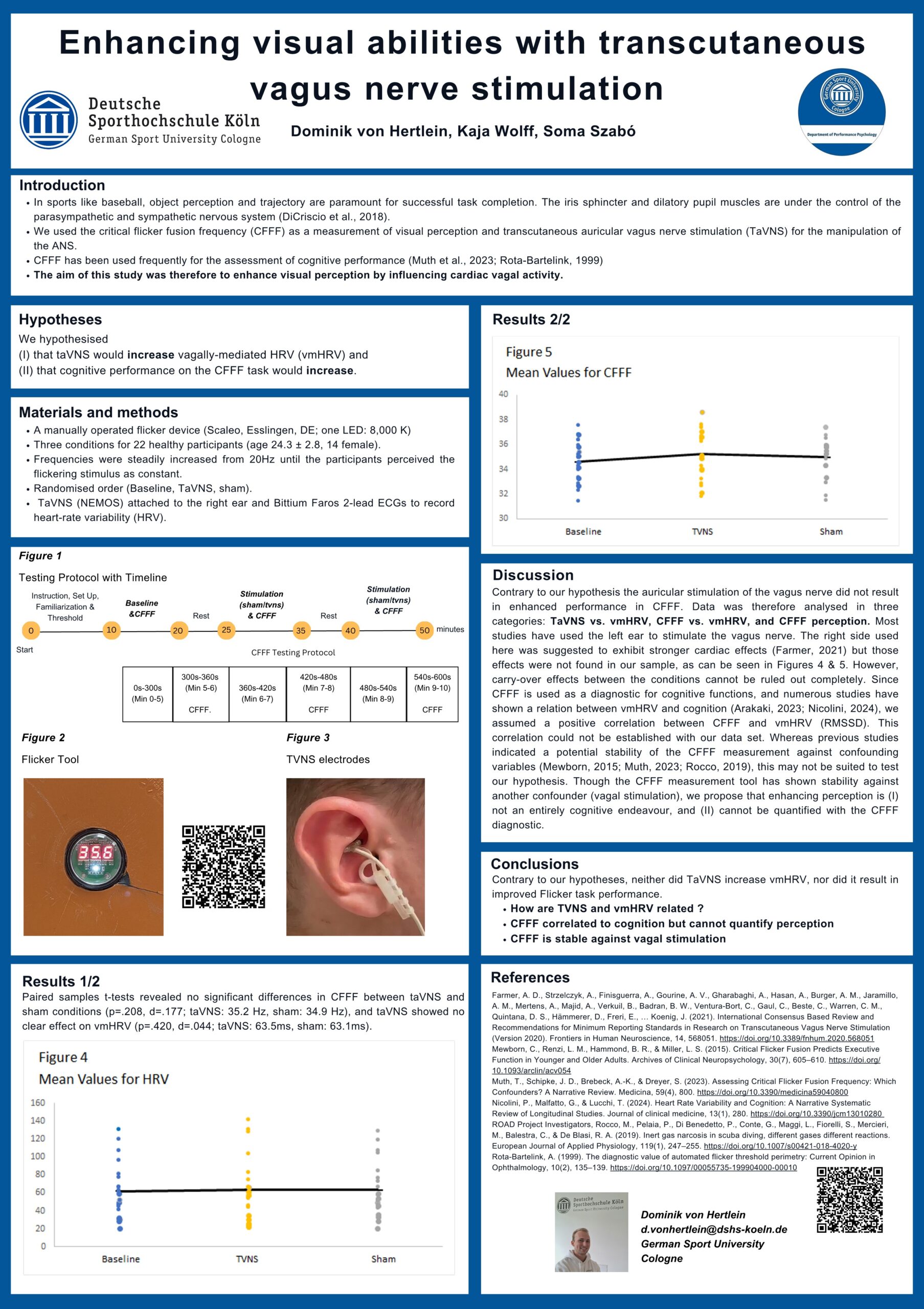
This study investigated how heart rate variability (HRV) and visual perception, measured by critical flicker fusion frequency (CFFF) are affected by transcutaneous auricular vagus nerve stimulation (taVNS). CFFF predicts cognitive functioning and measuring them in sensitive situations, such as head injury, can provide useful insights for both athlete health and high performance. Enhancing cognitive functioning with vagal stimulation may also provide opportunities for performance improvement in sports. We hypothesised (I) that taVNS would increase HRV and (II) that cognitive performance on the CFFF task would increase. 22 participants (age: 24.3+2.8, 14 female) were assessed for cognitive functioning. The assessment was done with electrodes from a NEMOS device attached to the right ear of the participants. HRV was recorded using a two-lead ECG (Bittium Faros). Data were analysed using a paired samples t-test. Our results indicated no significant differences of CFFF in tvns and sham conditions (p=.208, d=.177; tvns: 35.2 Hz, sham: 34.9 Hz) and no clear effect of tvns on HRV was established (p=.420, d=.044; tvns: 63.5ms, sham: 63.1ms). Contrary to our hypothesis the stimulation of the vagus nerve did not result in enhanced performance in CFFF. If, however, CFFF can adequately predict cognitive functioning or visual processing, the direct stimulation of the autonomic nervous system could be excluded as a confounding variable, but more research is needed to identify whether the changes in HRV represent a clear trend. It may be valuable to test CFFF in head-injury assessments in sports such as Rugby or American Football, where concussion symptoms and a decline in cognitive abilities need to be evaluated for player health and safety. Similarly sensitive environments such as diving, or mountain climbing may benefit from a quick diagnostic measurement as a risk assessment. In line with these current results, using this CFFF tool as an acute diagnostic provides great avenues for direct application but also needs more research to fully understand the mechanisms of taVNS and HRV on visual and cognitive abilities.